

- Guest post prices range widely, from $50 marketplace links to $3,130+ premium editorials, and price alone doesn’t predict ranking value.
- Only about 1.37% of available guest post inventory meets the quality bar needed to actually help rankings.
- Four factors drive price: Domain Rating (each 10-point jump adds roughly 32%), verified traffic, intermediary markup (up to 14x), and regulated niches carrying a surcharge.
- What actually ranks is relevance and real traffic, not raw authority. A lower DR site with strong topical fit can outperform a higher DR, off-topic one
Guest posting is the technique of writing a post for an outside website in exchange for a relevant link. This one practice commands staggering prices, from listing on the market at $50 to premium prices of $3,000 or more, and the price difference is rarely discussed in any detail. This article explains pricing, explains the jargon that buyers often mix up, and shows what really matters for rankings and what doesn’t.
What is Guest Posting?
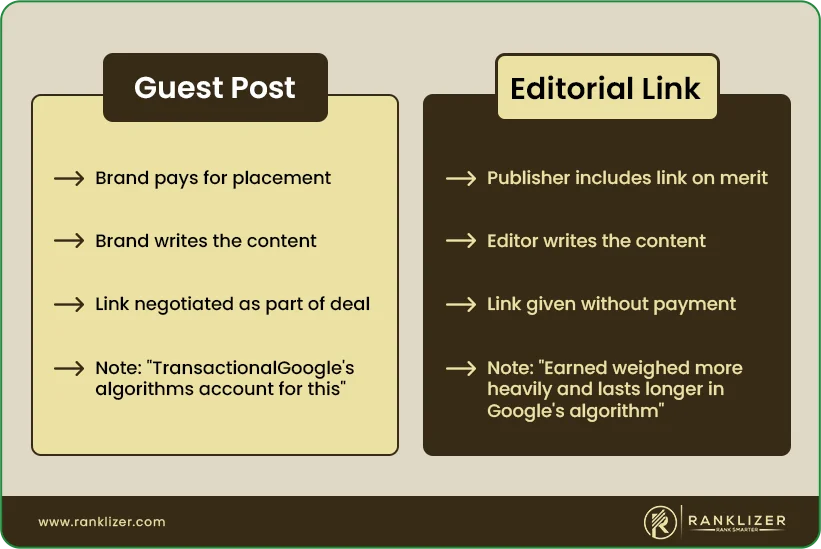
Guest posting is one of the link-building strategies in which a brand posts original content on a third-party website along with a link in the body of the text. A guest posting service usually includes both outreach and drafts, and places them. An editorial link, on the other hand, is a link given by the publisher because it adds value to the overall content of the page, without payment.
What is an Editorial Link?
Editorial link building is the larger umbrella under which many kinds of links are earned via research, commentary and contribution, and which might have been included by an editor without compensation; Google’s algorithms are designed to give such links more credit for a longer period than transactional links.
Pricing, by tier
| Site type | Typical price | What you’re buying |
| Low-authority sites (DA/DR 20–40) | $50–$300 | Basic placement, minimal editorial vetting |
| Mid-tier sites (DA/DR 30–50) | $300–$800 | Genuine editorial standards, moderate authority |
| Authority sites (DA/DR 50–70) | $600–$1,500 | Strong editorial friction, real audience |
| Top-tier publications (DA/DR 70+) | $1,500–$3,130+ | High-quality, high-traffic, premium editorial process |
What a single link costs, by the data source of the link
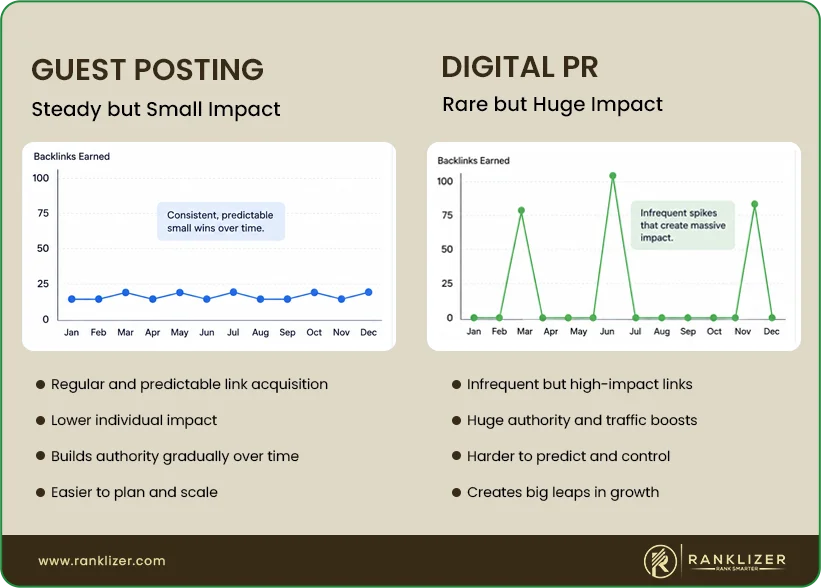
The latest BuzzStream pricing report (2026) sets a $461 average price per link for an average guest post, while the links for high-quality posts average $3,130 depending on traffic and authority. In contrast, digital PR links cost $1,250 to $1,500 on average and, as per that same analysis, are the most valuable tactic for authority and rankings. Much more important, just 1.37% of the guest posts are of any quality, which is exactly the kind of link Google’s anti-spam algorithms are built to penalize.
Adsy’s marketplace data, which includes more than 37,000 listings, suggests the price range of guest posts on websites ranging from DR 11 to 40 is $351 to $390, with websites in the DR 71 to 80 range charging an average of $1,008 for a guest post. That same study reveals that buyers typically pay far less than what sellers list, a gap driven largely by intermediary markup, covered in more detail below
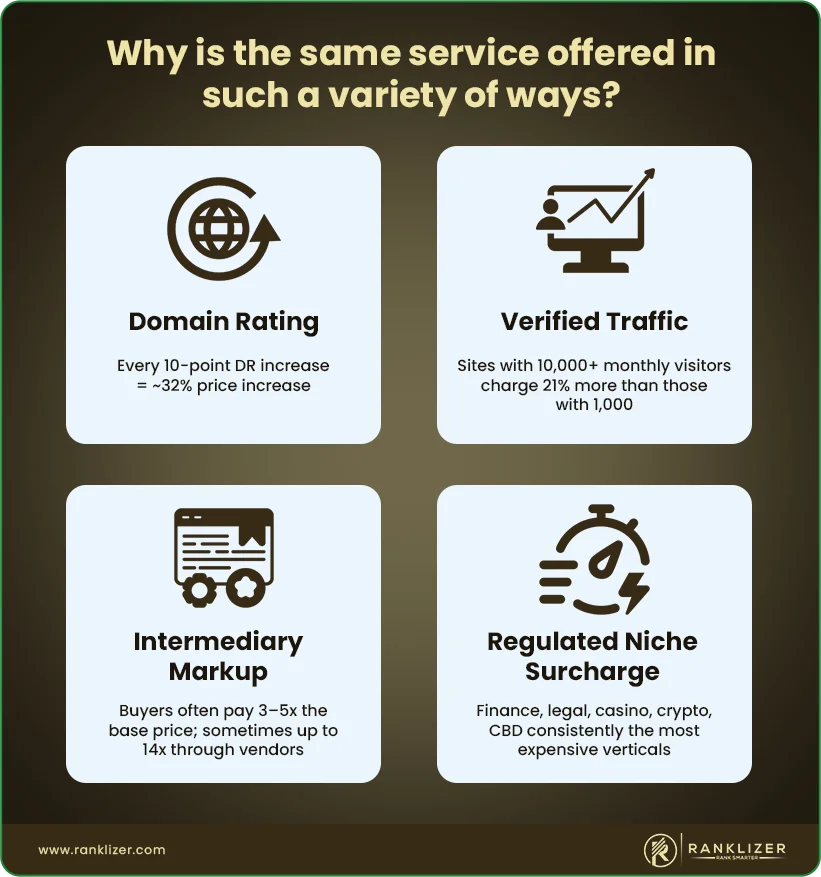
Why is the same service offered in such a variety of ways?
4 variables explain nearly all the variation:
★ Domain Rating is still the most powerful lever. On average, every 10-point increase in DR corresponds to a 32% increase in price.
★ Premium is enhanced by verified traffic. The publishers on the next step up, with more than 10,000 monthly visitors, pay 21% more than publishers with a thousand visitors, which is another $50 to $350.
★ There are significant cost over inflation from intermediaries. In many instances, these can end up costing three to five times as much as they would for the buyer, and sometimes fourteen times as much if you buy through a vendor.
★ The regulated niche is done with a surcharge. These five verticals are consistently named in pricing studies to be the most expensive verticals to build links in, and these verticals are known for compliance requirements and the reputational risk that comes with linking to them: Finance, legal, casino, crypto and CBD.
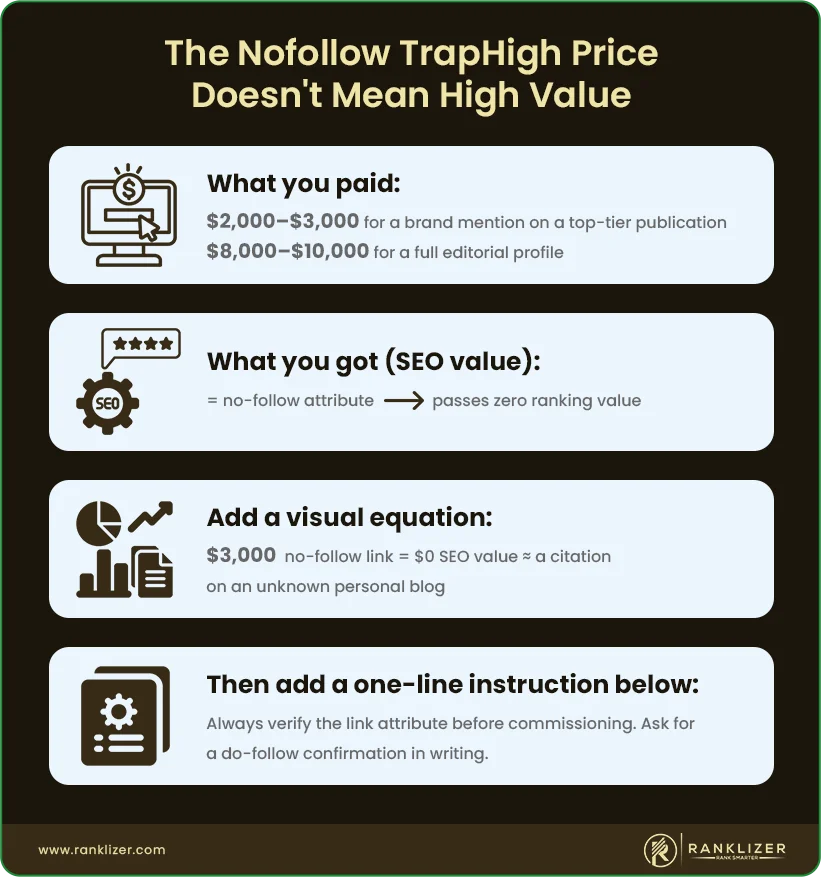
The no-follow trap
One problem that is not often offered up: Several prestigious publishers today use the no-follow attribute as a default on contributor links. Either a premium brand mention or a complete profile can run $2,000 to 3,000 and $8,000 to 10,000, respectively, but they don’t necessarily carry any real meaning in terms of ranking value; they’re excellent for reputation, however. Before commissioning any high-quality link, be sure to verify the attribute of the link, as a high-dollar no-follow link is, for SEO purposes, virtually the same as a citation on a personal blog site that most readers probably don’t know of.
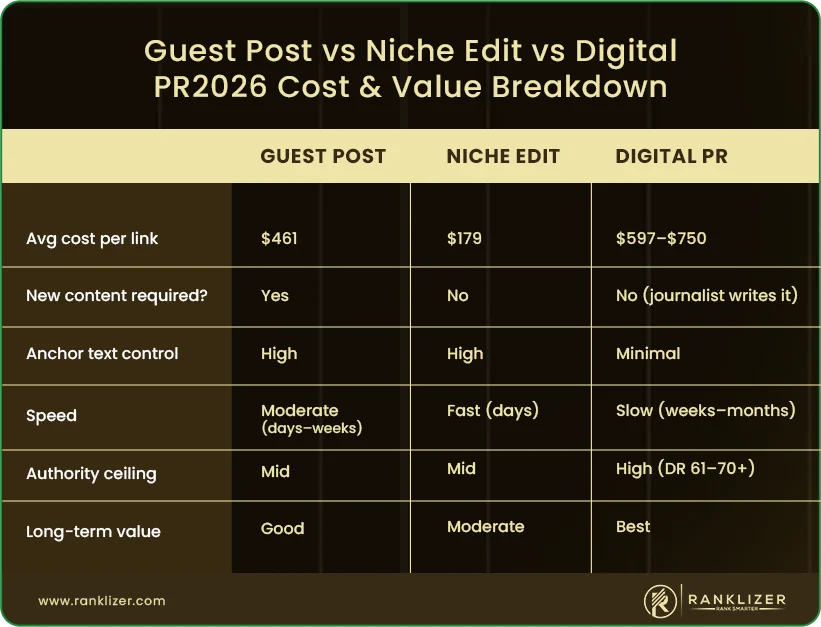
Guest posts, niche edits, and digital PR
A niche edit, also known as a link insertion, has one important distinction from guest posting: it does not involve the creation of a new page. A link is instead inserted into an article that already ranks and already garners organic traffic. At $179, they are significantly lower than the $461 of a normal guest post, and high-quality, high-traffic sites do not normally provide this option.
Digital PR link building is a link-building strategy that is achieved by creating newsworthy data, original research, and expert commentary that are pitched to journalists, but without the purchase of a placement. A well-designed digital PR strategy often brings in editorial links, which guest posting can only copy, at a fraction of the price per link once the campaign starts taking off. At the very least, it is the most lasting strategy for long-term authority.
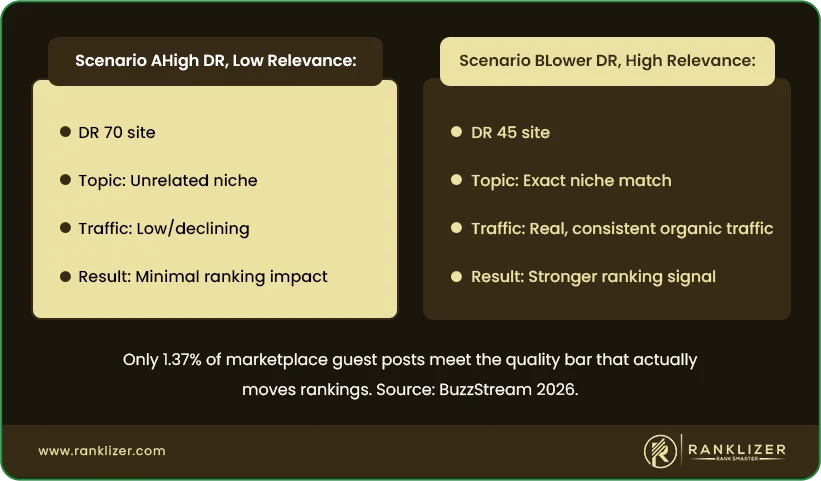
What actually ranks
What actually ranks is relevance and measurable readership, which always beats raw authority measures. Often, a DR 45 domain will outrank a DR 70 domain that is not relevant to the text, because topicality is a separate signal. If the quality of guest post content is the same as the quality of the page it is being posted on, the $50 marketplace link is likely to get very little value apart from risk. A link on a lower DR site with strong topical relevance and real traffic may generate more value than a link on a higher DR site with weak relevance and little traffic, and traffic is easily verifiable by search engines, whereas Domain Rating is comparatively easy to fake. For instance, AI Overviews often fetch content from authoritative sources that are linked to effectively, meaning that this is an area that will be even more important in 2026 link-building efforts than it is today.
Frequently asked questions
So what’s guest posting for?
Building backlinks, being a topical authority, and getting more traffic via referrals from other external but relevant websites.
What is an editorial link and how is it different from a paid guest post?
An editorial link is included simply for the merit of its content, and a paid guest post is included because the fee was paid, whether or not the surrounding text is truly helpful.
Is it more affordable to do niche edits than guest posts?
Yes, you can expect about $179 for your insertions as compared to about $461 for a typical guest post, because you are not creating content at all.
Are guest posts more effective at boosting rankings with a higher price tag?
No. While the authority and traffic behind the URL may be influential, price, the attribute link, dofollow versus nofollow, topical relevance and publisher trust have much greater impact on actual ranking than the cost of the URL.
What percentage of the guest post inventory is worth buying?
The most recent large-scale marketplace analysis shows that just 1.37% of available placements meet the quality bar that makes a meaningful impact on rankings, meaning the vast majority fall below that level.