

- AI tools (ChatGPT, Perplexity, Google AI Overviews) now give users one answer with a few cited sources
- If your brand isn’t cited, you lose the customer before they even visit your site
- AI-referred visitors convert about 2x better than regular organic traffic
- This guide shows you how to: track if AI mentions your brand, fix inaccuracies, and build the content and third-party presence needed to get cited more in 2026
If AI doesn’t cite your brand when a potential customer asks a relevant question, they get an answer that names your competitors — and most never look further. The reason this matters more than most marketing problems is that AI answers feel authoritative to the people reading them. When Google returns ten links, the user knows they are choosing between options, and they apply their own judgment. When ChatGPT or Perplexity returns one answer with two or three named sources, the user tends to treat that answer as already verified. Your brand being absent from that answer does not just mean you missed a click. It means the user formed a view of your category that does not include you, and that view is harder to change than a search ranking.
In 2026, most brands have no system in place to tackle this, and many brands are still not aware that this is a problem they should solve.
What Actually Changed
For a long time, SEO was all about improving the position of your page in the search results above your competitors. Rankings came first, followed by traffic, and traffic, in turn, was followed by revenue, and it worked pretty well for a long time. Then Google began to provide answers within the search results page itself, initially with featured snippets, then with AI Overviews, preempting any organic search result.
- ChatGPT became the fastest-growing consumer platform ever, reaching millions of users per week in just a few months.
- Google AI Overviews have now become present in approximately 25% of all searches (Conductor 2026 AEO/GEO Benchmarks Report), and this ratio continues to increase each month until 2025 and into 2026.
- Gartner forecasted that search traffic for traditional search would decline by 25% by 2026 (Gartner Press Release), and the data that’s available now shows that it did.
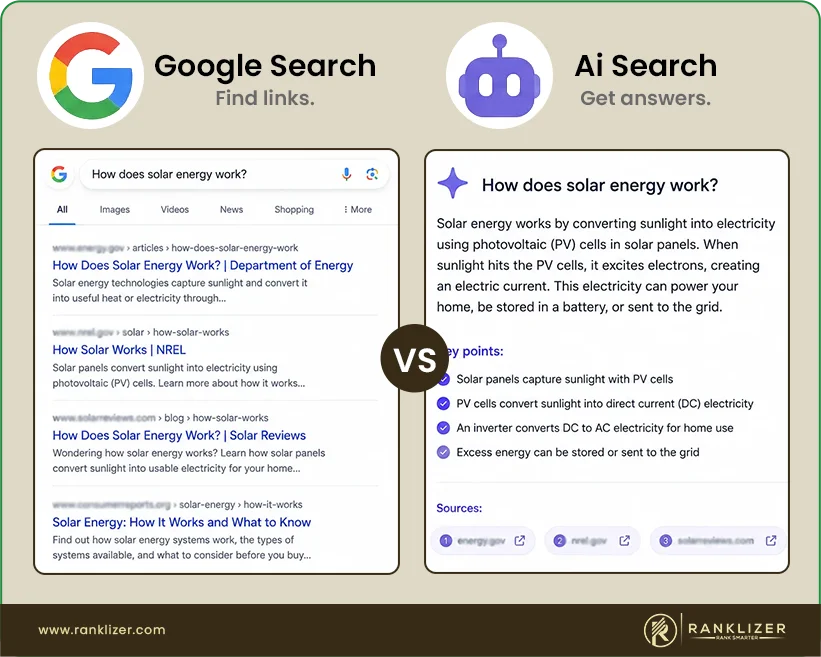
In the old days, search engines would provide a list of 10 blue links for each query, and the user was free to click on the link they deemed the best fit. Now, AI returns one answer, typically 1-2 paragraphs, and two or three sources are cited at the bottom of the answer. Your marketing team’s question has shifted dramatically. It’s no longer “where do we stand on Google?” The question now is: Does AI cite us at all and, when it does, what does it say about us?
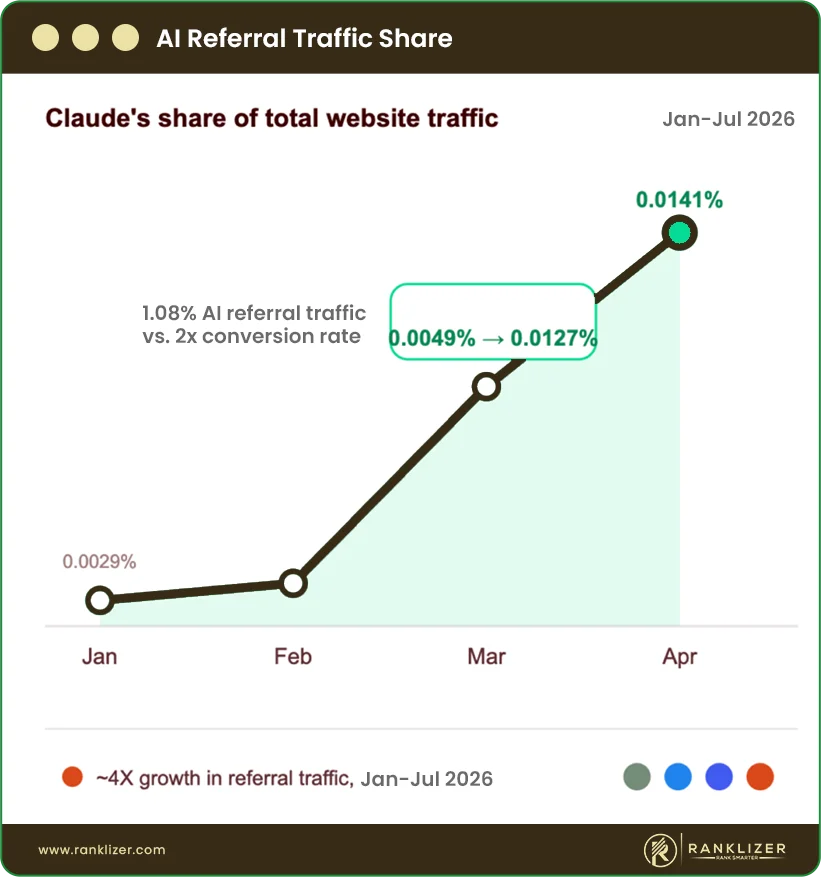
The Conductors 2026 study reveals that, across all 13,770 domains, AI referral traffic accounted for approximately 1.08% of all web visits. That’s small, but when you consider what those visitors do when they arrive! Users from AI citation conversion are about double the number of users from standard organic Google search. They are not just wandering around aimlessly. They’ve already encountered an answer that mentioned your brand as a relevant solution to their needs, and they’re primed to take the next step.
There are 4 Terms to Know
These four words are all used frequently in AI Search discussions, and they’re often confused. There are four things they describe, and each will need a different approach.
SEO (Search Engine Optimization)
SEO is the foundation upon which all else is built. This encompasses technical health, crawlability, page speed, mobile performance, backlinks, and internal linking. If they’re not working properly, then nothing you do in AI search Optimization will make any difference. The same signals used to determine the architecture of a site are used by both the AI crawlers and Google’s traditional crawlers, so if it’s slow or poorly built, it’s not going to show up in search results.
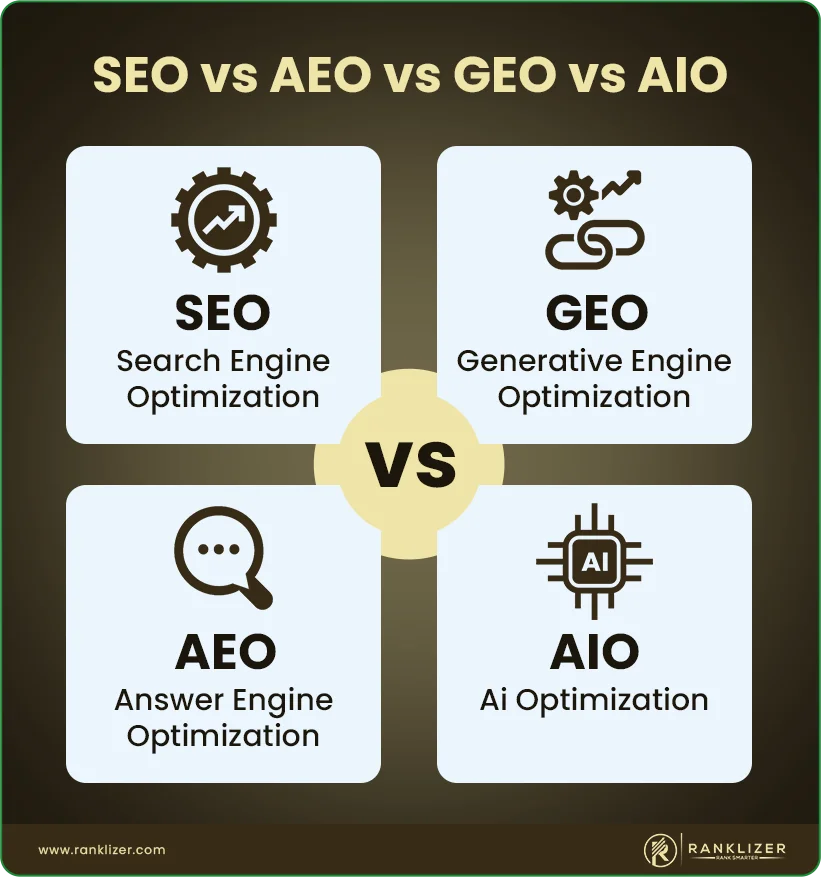
AEO (Answer Engine Optimization)
AEO (Answer Engine Optimization) is the process of getting pulled by the person when they ask a direct question. This includes featured snippets, People Also Ask boxes, voice search, and zero-click results. Content created for AEO should:
- Include the direct answer at the top of the page
- Be written in the form of a question
- Include FAQ sections that answer the most common follow-up questions your audience has
GEO (Generative Engine Optimization)
GEO is all about being referenced within AI-generated content from AI tools such as ChatGPT and Perplexity. These tools generate an answer to a user query by accessing information that they have determined to be authoritative, well-structured, and trustworthy. The ongoing process of GEO is to become one of those sources; by means of quality of the content, logic of the page structure, credibility of external references, and regular presence on the third-party pages that are already regularly drawn from by AI systems.
AIO (AI Optimization)
AIO (AI Optimization) is the trust layer that is under all of them. This layer is fed by reviews, citations from other websites, brand mentions on various sites and platforms, and the presence of the brand on various platforms. These signals build up over time, and inform AI systems that your brand is actual, trusted, and recommendable to users who ask pertinent questions. It is not a campaign that you can do in one go – it is a reputation that you build over time.
The four layers must all play a role in achieving the same level of AI visibility. The most frequent and costly error that marketing departments are making is running them as four separate projects with four different individuals or teams.
What is the Impact of Brand Visibility on AI Search?
AI platforms don’t rank websites in the same order as Google. They choose a limited number of sources, based on certain criteria, and give these sources as the full answer. It is important to know, more than any other knowledge you can have, what motivates that selection process.
There are three things that it is all about:
- The quality of the actual answer being provided in your content to the specific question asked.
- The clarity of your site structure enables the AI to navigate and retrieve data without losing context.
- The extent to which the wider web agrees that your brand actually understands the subject it’s discussing in the query.
According to a study by Princeton University on Generative Engine Optimization, content specifically designed for AI citation has higher citation rates compared to content that is not catered to these factors. The three key takeaways from that study were:
- Put the direct answer at the top of the content (not gradually working up to the answer)
- Use real numbers and specific data points that the AI can use directly as it reads the content
- Write content with a clear logical structure that the AI can follow from paragraph to paragraph without losing the thread.
The analysis of 17 million AI-generated answers and more than 100 million citations by the conductor revealed the most common content formats cited in Google AI Overviews:
- Long-form blog posts and articles were the first
- Video content came in second, with YouTube lording it over it in that category
- News articles and product pages soon followed
The detail of the finding on YouTube is that the YouTube domain gets the citation credit even if the video was created entirely by your brand. One of the best content moves to make right now is to publish your expertise as video content on YouTube and embed the video throughout your website.
Reddit was always cited in several industries. AI isn’t just searching for polished corporate content. It’s searching for genuine skills anywhere they could possibly be discovered online, and that includes user forums, community threads, and industry discussions.
The Places Where Brands Are at a Disadvantage Right Now
Financial Services
The most telling example of the current research is the financial services data. NerdWallet and Bankrate have been the top performers for citations for AI in the financial industry, topping the list across the category in Conductor’s financials analysis. NerdWallet accounts for 6.73% of the AI market share in financials, and many of the country’s top and well-known banks are barely present in the citation data. It’s a simple reason. NerdWallet has created thousands of articles directly answering specific financial questions in plain English that people search for. Traditional banks do not publish product pages, regulatory disclosures, or press releases that respond to any meaningful question that a customer may enter into an AI platform.
In AI-driven search, the depth of content trumps brand recognition, and this is true across all industries studied.
Healthcare
This is the same pattern in the health domain, but with the roles reversed. When it comes to healthcare AI citations, Mayo Clinic and Cleveland Clinic stand head and shoulders above all other healthcare providers in the data. Both organizations have developed what they call Health Libraries – vast amounts of expert-written content that provides the answers to thousands of specific medical questions in a way that is easily readable and citable by AI systems. Even if the clinic was well known in its local area, the AI answers will be missing a smaller clinic with only 5 service pages and a contact form. A smaller clinic with 5 service pages and a contact form won’t show up in AI answers, no matter how popular it is in its local area.
The same trend is seen in other areas of the research, including retail, professional services, real estate, and others. The brands with the most AI citations have developed editorial libraries that are able to solve actual questions. They are also regularly seen in third-party sites AI has already read, such as industry publications, review sites, and forums where genuine conversations about the category take place. A robust marketing budget or a brand name will not stop the cracks in the content from spreading when the content is thin.
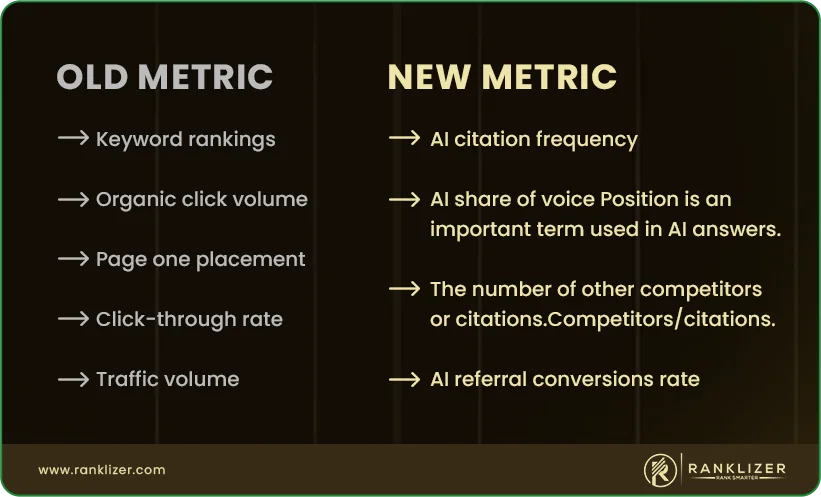
The Metrics That Matter Now
Your teams’ metrics should extend beyond the traditional data that Google Analytics gathers.
| Old Metric | New Metric |
| Keyword rankings | AI citation frequency |
| Organic click volume | AI share of voice |
| Page one placement | Position is an important term used in AI answers. |
| Click-through rate | The number of other competitors or citations.Competitors/citations. |
| Traffic volume | AI referral conversions rate |
Don’t assume that adding the additional metrics means that you’re going to replace your current Google Analytics reporting. Organic search is still responsible for the bulk of traffic to websites in all of the industries in Conductor’s data. In the healthcare sector, it makes up 42.4% of all traffic. In professional services, it’s at 33.8%. The AI referral traffic is increasing, month-over-month, but is not likely to surpass the traditional search traffic in a timeframe that would warrant a complete change in strategy.
The idea is that AI visibility is a standalone channel that impacts the user’s perception of your brand before they click anything, influences their brand perception prior to getting on your website, and provides better-intent visitors when it does drive traffic your way. However, just using the traditional metrics is missing out on a growing and high-value component of the way that customers discover and assess brands in 2026.
AI Search Tracking Your Brand: How to Do It
But the vast majority of the brands don’t know if AI is referencing them or if the citations are correct, and that other brands are being recommended instead in the most important queries. The one thing that is missing in most marketing teams most of the time when it comes to practice is this.
This is the starting point and is free of charge and requires a few hours. Open up ChatGPT, Perplexity, and Google and run the 10 questions your customers ask most frequently before making a purchasing decision. Write down if your brand is mentioned, in what part of the answer and what the AI is saying about your brand. Next, compare all of the results you get when you perform the same searches for your three main competitors.
In that time-consuming task, you get a true gauge of where you’re at with the platforms that are most relevant to you at the moment — and most brands are surprised at the results.
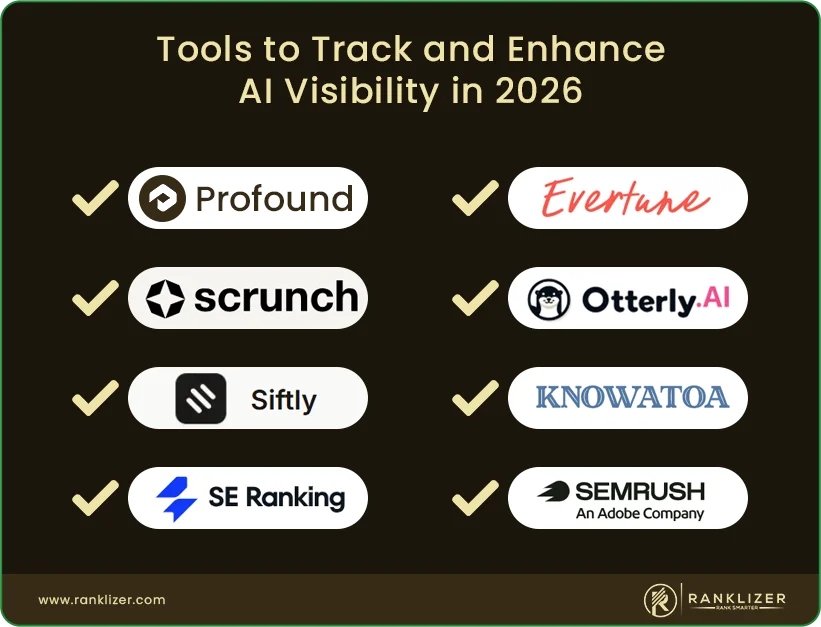
Tools to Track and Enhance AI Visibility in 2026
- Profound analyzes ChatGPT, Claude, Perplexity, and Google Gemini and offers insights into how often each model is mentioned, how it is cited, and how it is positioned in relation to the competition on all four platforms. Designed for bigger teams with multiple brands or more complicated portfolios, the pricing reflects this positioning, and if you’re at that stage, it may be worth considering whether the depth is worth the price tag.
- Evertune monitors brand mentions on ChatGPT, Claude, and Perplexity, providing geographical breakdowns to reveal the varying levels of AI visibility across regions. Scheduled reports and custom dashboards are available. The downside to this is that it doesn’t track all of the information for mentions beyond the point of them showing up on your site; it only shows you the citation, not the rest of the journey of what they do after they get there.
- Scrunch AI keeps an eye on your brand visibility across the major AI platforms and then uses this data to generate content suggestions that truly generate citations within your specific category. It highlights the topics and keywords driving your AI visibility and offers specific tips for boosting your citation rate. This is more suited to teams that want to take action based on the data, rather than reporting on it.
- Otterly is the most accessible option for teams with tighter budgets. It includes the main AI platforms that lack some of the more sophisticated features found in enterprise products but provide smaller teams with a real monitoring baseline without an excessive monthly investment. It is a good place to begin to understand their AI visibility without signing up for an enterprise engagement.
- Siftly is a real-time competitive intelligence service for ChatGPT, Google AI Overviews, Gemini and Perplexity. If you’re in a classification where the percentage of the voice of AI is changing rapidly, and you need to monitor the changes, week by week instead of month by month, then it’s worth testing.
- Knowatoa is not just about tracking the presence of your brand name; it’s about tracking specific brand attributes such as product names, leadership names, and key differentiating features. It includes seven AI platforms, such as Meta AI and Google’s AI Mode. It’s great when you want to see how AI is engaging with a specific product claim or specific feature, instead of just seeing brand activity.
- SE Ranking is a classic SEO suite that has introduced AI visibility tools. Perfect for teams that want to get Google rankings and AI citations in 1 report, and don’t need to run 2 separate tools. The AI analytics data is not as comprehensive as what can be found on the dedicated platforms, but the merged data offers tangible benefits for lean teams operating both channels.
- Semrush One is an AI visibility tracking SEO tool. This is the quickest way for any team that already uses Semrush to incorporate AI monitoring, without introducing another vendor and another reporting method.
A Practical Plan to Get Started This Week
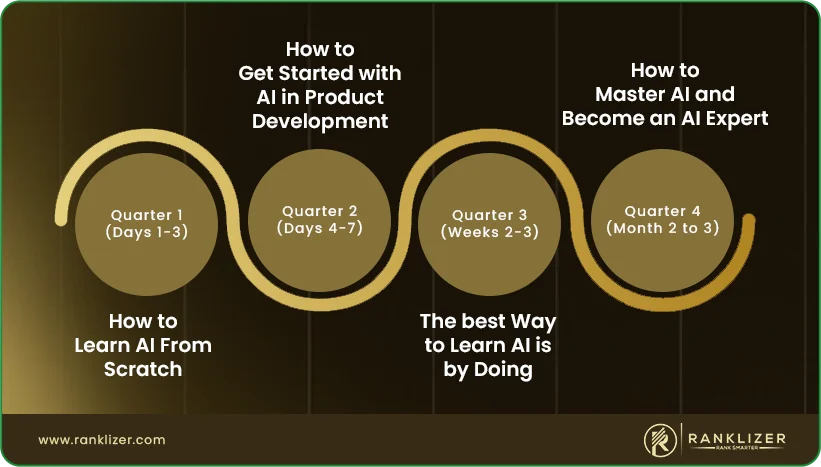
Days 1–3: Understand Where You Are Now
Explore the top 20 most critical brand and category queries on ChatGPT, Perplexity, and Google AI Overviews, and note their presence, ranking, and AI sentiment on your brand. Type in the same queries for your three main competitors and note the differences between the AI’s opinion of them and yours. This baseline is free of cost and provides all subsequent decisions with the information they need.
Days 4–7: Structural Fixes to Your Most Significant Pages
- See if each page starts with an answer to the question being answered, or background information, or company history.
- Make sure headings are in the form of a question and not just a label for the topic.
- Review each page to see if there is any original data, specific statistics, or direct quotes from experts that an AI system could collect and cite
These structural changes have the greatest return on investment relative to time on this list.
Weeks 2 and 3: Third-Party Presence
Focus on creating a real presence within the third-party sites that AI can tap into. When deciding citing your brand, AI systems read far more than your own website. Know which specific publications, review platforms, and industry forums are linked when your competitors are referenced in AI-generated answers. Get your brand talked about and quoted on those very same platforms via PR outreach, authored articles, expert commentary, and review generation campaigns.
Month 2: Set Up Automated Weekly Tracking
Depending on your budget and team size, pick one of the above tools, set it up to report weekly, and create a standard summary that will give you a view of how you’re doing with AI citations on your top 10 queries, how much voice you’re getting compared to your main competitors, or any instances where an AI platform is describing your brand or products in a factually incorrect manner.
Month 3: Fill Content Gaps
Trace the entire customer journey and document all the questions that they ask at each step of the process; then determine which of the questions your website isn’t responding to well. Create a page or article for each gap you discover, and focus on those where your competitors are showing up in AI answers and you aren’t showing up at all.
What Happens When AI Gets Your Brand Wrong
Nearly all of the tools in this space are created to boost brand visibility within AI answers. Few of them touch on the other, just as significant, issue of how to deal with AI’s occasional factual inaccuracies about your brand.
AI systems can misrepresent what your product does, credit a competitor’s feature to your brand, or consider one negative review as a reflection of the views of the majority of your customers. These mistakes remain in the system in all subsequent queries on the subject until the underlying model is retrained—and retraining can take months at the big AI platforms.
The monitoring tools mentioned above will indicate when your brand name is used in an AI response. What most teams fail to do, however, is verify the accuracy of the AI’s statement instead of just noting when the statement was made. If you have identified errors, the safest way to fix them is to make the accurate information more eye-catching and easily accessible for the AI to pull up on your site and on the third-party sources where the AI is most likely to find the information. At this time, there is no official way to challenge or correct factual inaccuracies in AI-generated content for any major AI platform. There’s really no other way for brands to do it right now, to make the right version of the info more prominent and more widely cited.
Linking AI Visibility with Revenue
Eventually, someone in your organisation will ask you, “What does AI visibility actually contribute to revenue?” and that’s a perfectly valid question that deserves a true answer instead of a vague mention of brand awareness.
People who visit from the AI citation convert at double the rate of people who visit from regular organic Google traffic. These people have already read an answer on your site that mentioned your brand, and it was relevant to their needs. A lot of consideration and qualification have already taken place before they arrive at your page. The journey from initial mention of AI to final purchase is clearly shorter than that of the traditional journey from a Google search.
The key to measuring this is to link your AI visibility tracking with your CRM. Include the source of the new leads in your usual lead acquisition routine. If sales originate from a session that’s been AI-referred, keep them separate from other traffic sources. You’ll have enough numbers after four to six months of this type of consistent action to put a real number on your AI share of voice, and that number will make budget discussions with finance and leadership simple, instead of principled.
What This Comes Down To
AI search is a true channel, and it’s gaining momentum by the month and most brands are not measuring what it measures, are not building for it, and are not tracking it. Unlike most types of traffic, the folks who come on AI citations already have a head start before they come to your site. This means that the folks who arrive on AI citations are already qualified before they reach your site, which is a huge distinction from traffic from most other sources. The brands that are getting those citations now have:
- Created a good content library that fully addresses real questions
- Maintained a valid presence on the third-party sites AI is mining from
- Kept an eye on their AI presence weekly (and not once a quarter)
- Caught errors and filled content gaps before a competitor could get in the door
It is not necessary to have a completely different strategy to play in an AI search. You have to continue doing what you’ve already done with content and SEO and adjust your approach as it relates to how AI systems select and cite sources – and then measure it as rigorously as you do every other channel in your marketing mix.
There are tools available to do this, and they are on the shelf now. These brands that move in 2026, will be more difficult to out-compete than those that are undecided if it’s worth their while.