
- Arabic link building in the Gulf is not English SEO translated. It needs its own strategy for language, technical setup, and publishers
- Fix hreflang and RTL properly. Use country-specific tags for top markets, avoid regional codes, and never rely on machine translation
- Links come from genuine native Arabic content, original regional data, and video, since thin or translated content gets flagged fast
- Track performance by country, not just by language, and rule out technical issues before blaming underperformance on links
Most link-building playbooks are authored for English-speaking markets and then somewhat modified for all other markets. This is not a good idea in the Gulf. Saudi Arabia, UAE, Kuwait, Qatar, Bahrain and Oman are a whole new ecosystem with its own language dynamics, its own trust signals, and its own publisher landscape. One of the most common pitfalls is to use the same approach for campaigns in the Gulf and in England.
In 2026, a serious approach to Arabic link building will involve the following: understanding the differences between markets and sub-markets in the Gulf; keyword research methods for each dialect; the technical aspects (hreflang, RTL, localisation); the content and publisher strategy that really gets links; and measuring success or failure.
There are a number of reasons why Arabic link building is essential these days.
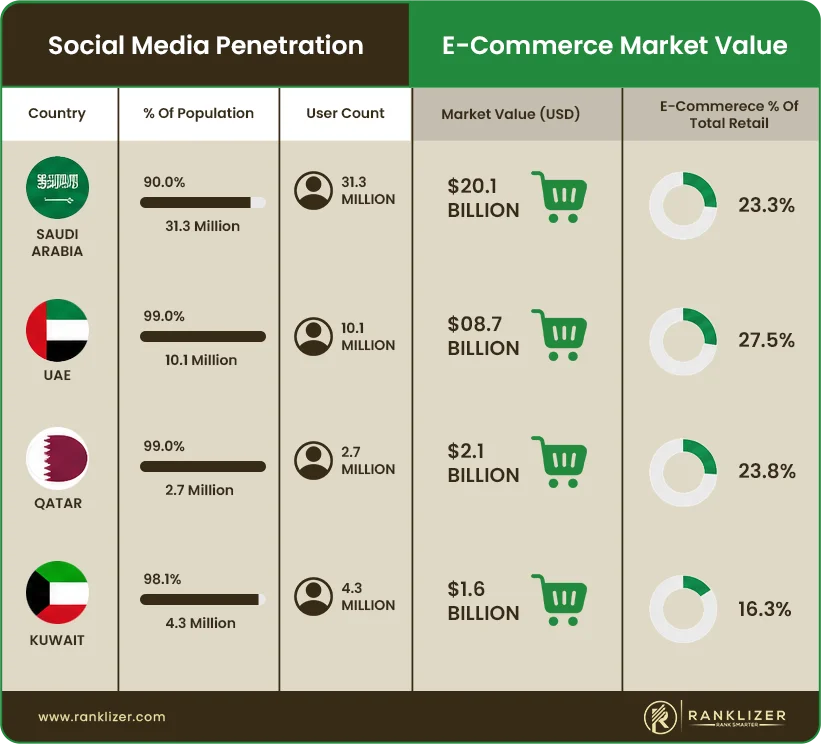
The investment case in the Gulf is no longer a gamble. This is a full business case. DataReportal estimates that by the end of 2025, Saudi Arabia’s social media penetration rate will have reached around 99%. In some counts that can be more than 100% of the general population, as many people have several accounts on different platforms. The UAE has a higher social media penetration rate of 99%, closely followed by Qatar (96.4%) and Kuwait (94.8%), compared to the global average of approximately 64% (DataReportal, 2025).
The commercial opportunity tracks the connectivity. The e-commerce market in the GCC region was expected to reach around USD 584.8 billion by the end of 2025. The region is likely to see its e-commerce market exceed USD 2 trillion by 2034, based on industry estimates cited in regional e-commerce reports. A broader view of the Middle East and Africa e-commerce market suggests that by 2026, the region will be worth $176.68 billion, and by 2031, the value of transactions will exceed $338 billion, with Saudi Arabia accounting for approximately a third of the region’s total transactions. Mobile is the preferred channel: in the region, mobile has already accounted for over 70% of B2C e-commerce transactions, and this is set to increase as more cities roll out 5G coverage.
The audience is here, spending is on the rise, and, unlike the English-language Web, there is notably less competition for the Arabic Web and fewer authoritative sites to compete against for rankings. This is why link building in Arabic is a more effective SEO investment for brand-new companies entering the market in the region.
The Gulf Is Not a Single Market
A frequent error is creating one “Arabic strategy” and targeting it at the entire region. There are significant differences among the Gulf states in terms of language behaviour, competitive density and audience sophistication. One size does not fit all.
Saudi Arabia is the largest and most populous digital spend market in the Gulf. Saudi viewers are looking for Arabic content that is deep and local, not translations. Saudi readers and Saudi publishers don’t like fluffy pages.
The UAE is more cosmopolitan and bilingual, and Dubai in particular. Many people are comfortable with English, and hybrid methods can be used, but this should not be an excuse for not using Arabic. A significant and growing share of consumer queries to Google’s UAE site are now in Arabic script, while a further portion contains Arabic and English in the same query, such as an Arabic word written in Latin script followed by an English word.
That’s a good thing for a new site in a smaller market like Kuwait, Qatar or Bahrain, as there is less competition for the domain name, and less content to outrank.
Although not as mature as the other Gulf countries, Oman is on the upward trend, and internet penetration and e-commerce are on the rise.
The difference between a real regional strategy and a campaign optimized for English and translated is making this market-level distinction in your keyword research, content prioritisation, and even your hreflang architecture (more on that below).
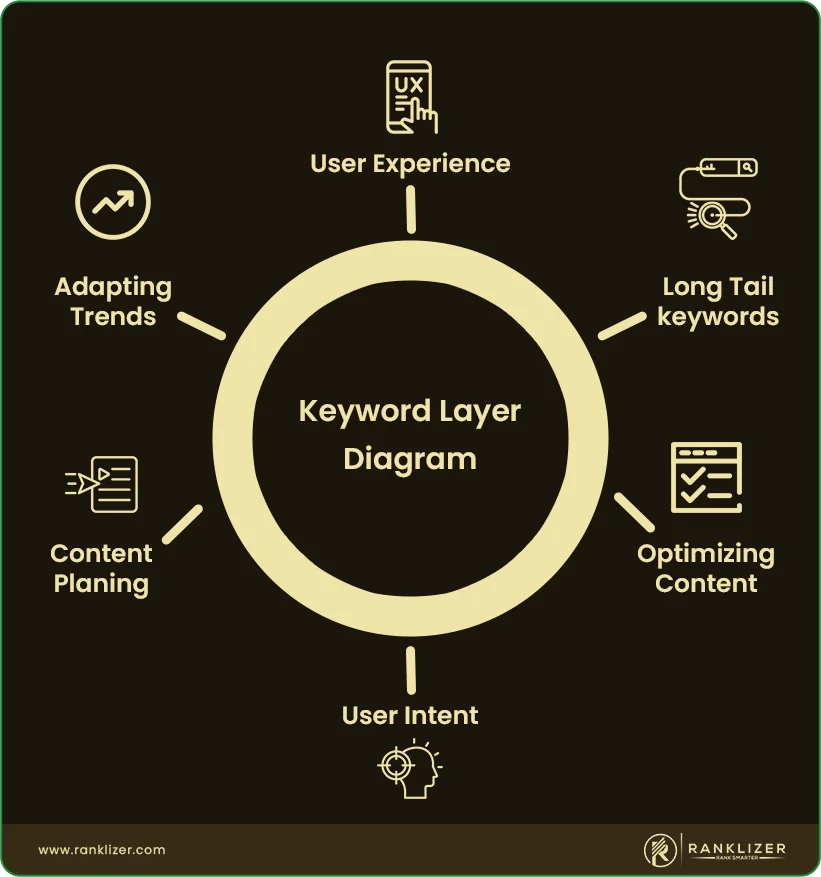
How People Actually Search in Arabic
The majority of Arabic SEO campaigns fail before they even get any backlinks. Arabic is not a single search language. It’s a lot of layers, one on top of the other.
Modern Standard Arabic (MSA / فصحى): the formal, written standard, taught in schools and used in most news media. It’s the safe bet for content that is relevant to the Arab world, and it’s Google’s best chance.
Dialect Arabic is what people use when they go online to search informally for local services, products, or for common questions. The search volume for an MSA keyword may be very different from its dialect counterpart. The volume of the two versions can differ significantly for the same search intent, and optimizing for formal Arabic can be challenging when considering phrases people use.
In technical categories such as SaaS, finance, and health, where there’s no natural Arabic equivalent to an English term, users code-switch or transliterate partway through their query. Hybrid queries (Arabic-English) are becoming more and more popular. Dozens of technical and consumer-tech terms are used in the same way, like “SEO,” which is usually searched in transliterated Arabic form, not translated.
In Practice
Use Google Keyword Planner (not ‘Arabic’ per se, but the country you are targeting) and Google Trends to compare regional interest, these are the best volume indicators.
Use Ahrefs and Semrush in Arabic as directional tools only, but be aware that there is more noise, particularly for long-tail and dialect words, where the volume figures may differ between the tools, double-check before creating a content plan based on one number.
Make groups of keywords for MSA, dialect and hybrid/transliterated versions of your core terms. Remember that one does not necessarily imply the other.
For campaigns that are targeted exclusively to the Gulf, use MSA and sprinkle in some words from the Gulf dialect. The heavier the colloquial Arabic, the more it resonates with markets such as Egypt, and the lighter the Gulf-dialect vocabulary, the more it resonates with the Gulf itself.
The Technical Foundation: Hreflang and RTL
If you have a technical setup telling Google not to index your Arabic pages, it will not affect the number of links you can build. This is the part many other Arabic SEO content pieces fail to focus on. It’s where otherwise well-spent campaigns go down before they even get to the links.
The Right Way to Implement Hreflang
In an international SEO setup, Arabic hreflang is one of the most frequently broken elements. Google does not recognise a significant number of Arabic language sites with hreflang tags, typically because they do not have a hreflang tag on the other language version, or because they do not use a supported regional code.
The first rule: no regional Arabic hreflang code. Google does not partially honour the tag for ar-MEA or ar-GULF. It just doesn’t help them.
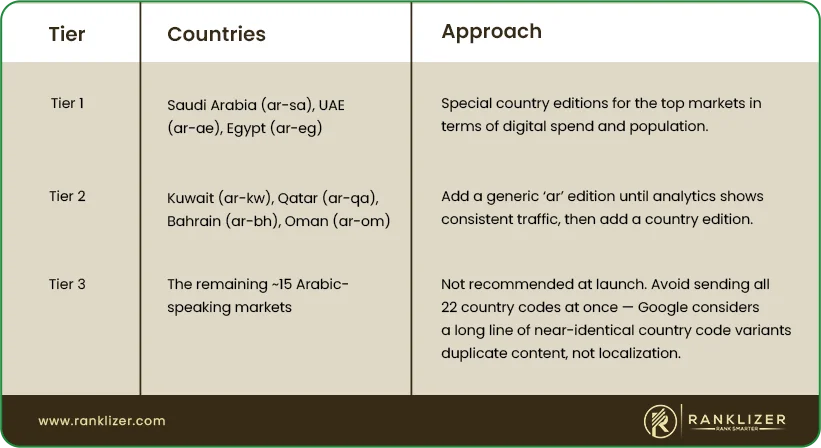
A realistic tiering for brands to target the Gulf market:
| Tier | Countries | Approach |
| Tier 1 | Saudi Arabia (ar-sa), UAE (ar-ae), Egypt (ar-eg) | Special country editions for the top markets in terms of digital spend and population. |
| Tier 2 | Kuwait (ar-kw), Qatar (ar-qa), Bahrain (ar-bh), Oman (ar-om) | Add a generic ‘ar’ edition until analytics shows consistent traffic, then add a country edition. |
| Tier 3 | The remaining 15 Arabic-speaking markets | Not recommended at launch. Avoid sending all 22 country codes at once, Google considers a long line of near-identical country code variants duplicate content, not localization. |
A standard baseline hreflang implementation for a site that serves the UAE is as follows: ar-AE (Arabic version), en-AE (English version), ar-SA (Arabic version, for traffic from Saudi Arabia), x-default (English version). Each tag must have a reciprocal link, Google does not recognise a one-way hreflang tag.
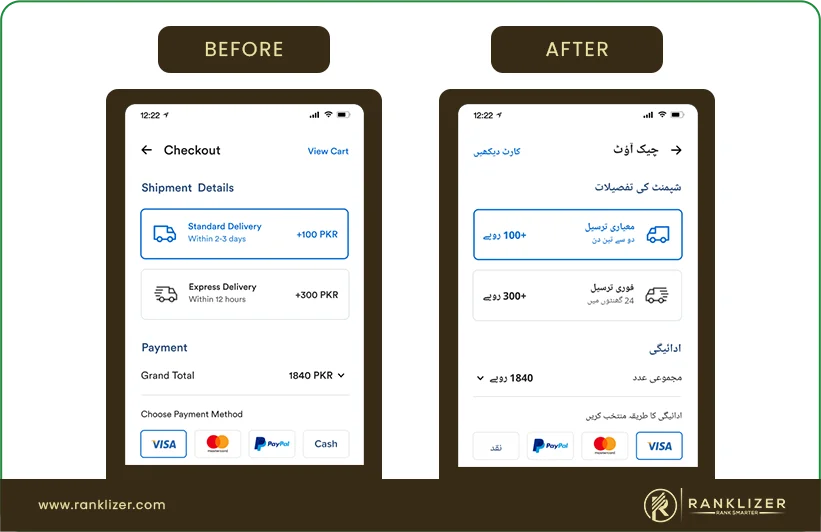
Translation is not localisation, it’s RTL and cultural adaptation.
The two most frequent layout issues that can mar an otherwise good Arabic page are broken right-to-left layout and machine-translated content. A real RTL implementation not only changes the direction of the text but also flips icons, padding, and form fields, and font stacks must have a proper Arabic fallback, not a generic system font that looks unprofessional on many devices. Content created by native speakers in Arabic is always better than content that has been translated from English. Google’s Arabic AI Overviews are now available in the Gulf, and the distinction between translated pages and those with real Arabic content is clear to the algorithm and to humans.
Content That Actually Earns Links
Two things are true at the same time: there are fewer high-authority Arabic sites than there are English sites, so it is more difficult to find a good site to publish on; and if there were as much good-quality Arabic content as there is English content, it would rank more slowly, simply because there’s less competition for Google to sift through.
That lack of supply is a two-way street when it comes to content expectations. If the content is thin or keyword-stuffed, it will be flagged more quickly, as there isn’t much “normal” Arabic content around it to blend in. The content that gets linked in this context tends to share some common characteristics:
Whether it’s an original data set or a research study, if it’s relevant to the Gulf market, it’s a legitimate reason for a publisher or journalist to cite and link to you: a report on e-commerce growth in the region, a survey of local buying habits, an original benchmark study.
Content that is in-depth and answers your audience’s real questions, and is relevant to the Gulf specifically, not a generic MENA-wide approach.
Even if it doesn’t get direct backlinks, video matters. Both video and voice-assisted search are popular among Gulf audiences, and video drives the engagement and brand recognition that lead to editorial linking.
Guest Posting and Publisher Strategy
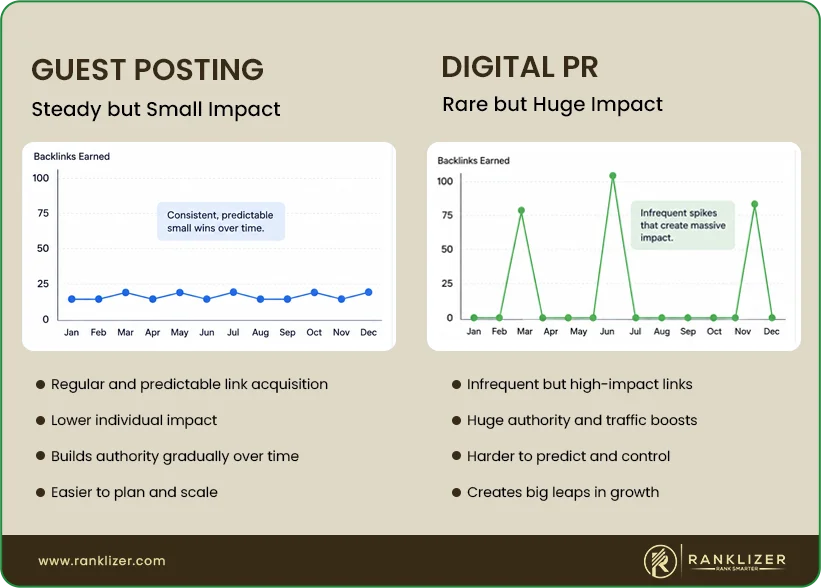
Guest posting is one of the best Arabic link-building levers, but the quality bar for the site must be higher than in English markets, as there are fewer quality Arabic sites and more low-quality ones trying to fill the gap.
Before seeking a placement, look for:
Genuine organic search visitors from Gulf countries. DR/DA scores can be gamed or outdated; cross-reference with real traffic.
Topical coherence. If a site has a high authority score but publishes across unrelated topics (healthcare, car insurance, cryptocurrency, interior design) without a clear focus, it can be considered a link farm.
Evidence of editorial standards, who is writing, how it’s edited, whether it is gated or open to everyone.
Indexation. Verify that the site’s articles are actually indexed by Google. If they aren’t, the site’s relevance won’t matter.
Examples of legitimate Gulf publishers to target (check each against the criteria above, don’t assume by category):
Arabian Business, Zawya and AGBI (Arabian Gulf Business Insight) are regional business and finance publications that accept contributed analysis in relevant categories.
National news outlets with strong digital presence, such as the UAE’s Gulf News and Saudi Arabia’s Arabic-language Arab News, are among the top-trafficked newspapers in their countries, respectively.
Digital wings of broadcasters, such as Al Arabiya, carry high domain authority in the region in both Arabic and English news.
Niche and vertical Arabic blogs and trade publications specific to your industry are less common, but often deliver the most relevant referral traffic and the most authentic links.
A good guest post feels like it’s written by the publication’s own editorial team, not as an advertisement for the author’s services, the link is woven into the content, not tacked on as an afterthought.
Influencer-Assisted Link Building
Gulf markets differ from the West because their influencer marketing campaigns are not necessarily direct-response oriented. The value of link building here is not a single sponsored post, but a long-term association, an interview, a piece of information the influencer’s audience would want to refer to and link to naturally. Micro-influencers who have built themselves up as a trusted authority in a particular field (finance, real estate, tech, beauty) are more likely to create sustainable, organic-looking relationships than a one-time partnership with a macro-influencer.
Measuring the Effect of the Work
The same basic backlink metrics still apply, but they must be viewed through a regional prism to be of any value:
Monitor referring domains and Domain Rating growth specifically from Arabic and MENA-relevant domains, not just the total number of backlinks.
Track keyword rank by country, not just by language. A keyword ranked highly in UAE search results may rank very differently in Saudi search results for the same query.
Track traffic growth in target countries specifically. Growth in Dubai and Abu Dhabi traffic matters more than global growth for a UAE campaign.
Review the traffic coming from acquired links. A good backlink should drive real traffic, not just carry a high metric. If a domain is authoritative but isn’t sending any referral clicks after you’ve acquired the link, investigate before assuming the link is working.
Check the technical implementation of hreflang and RTL before assuming a performance issue is a link issue, this is one of the most common non-link reasons for underperformance.
Frequently Asked Questions
Q: Is Arabic link building the same as English link building, merely translated?
A: No, it’s genuinely different. Beyond language, the publisher landscape is smaller and less consistent in quality, keyword behaviour varies across dialects, and technical issues such as hreflang and RTL introduce failure points that don’t exist in English-only campaigns.
Q: Where in the Gulf should a brand focus first?
A: It depends on your product and budget: Saudi Arabia has the biggest addressable market, the UAE is the most bilingual and has the highest digital spend per capita, and Kuwait, Qatar and Bahrain offer lower competition and a quicker path to topical authority.
Q: Is a dedicated Arabic version needed for each Gulf country?
A: Not initially. Use a specific edition for Saudi Arabia, UAE and Egypt, and a generic Arabic edition for smaller markets. Once analytics show consistent traffic from Kuwait, Qatar, Bahrain or Oman, add a country-specific edition.
Q: Should content and outreach use Modern Standard Arabic or a dialect?
A: For most Gulf-targeted content, MSA with light regional vocabulary is the right choice. For conversational or advertising contexts, heavier dialect performs better than formal Arabic.
Q: When is it acceptable to use machine translation for link-building content?
A: Never, for any content that seeks links or trust. Native-language content consistently outperforms translated content with Gulf audiences and publishers, and Google’s Arabic AI Overviews increasingly favour sites with genuine Arabic expertise over translated pages.